
Home alarm upgrades
Got an alarm that still works, but only just? Most of the systems we are called out to look at are not broken. They are simply older than the way people now live — a bell-only box on the front wall, a keypad by the door, and no way of knowing anything has happened until a neighbour rings you.
ITD Secure is an independent, Bearsted-based security firm covering the whole of Kent. We will look at any alarm system, whoever fitted it and however old it is, and tell you honestly what it is still worth. Where an upgrade genuinely buys you something we fit Pyronix and Ajax systems specified around your property. Where it does not, we will say so — sometimes the answer is that your system is fine and needs a service, not a sale.
Rated 5.0 across 50 Google reviews.
Book a free assessment on 07508 384864, or send us a WhatsApp.

The short answer
A home alarm upgrade usually means replacing an ageing panel and detectors with a wireless system you can arm, disarm and check from your phone. In a typical house it is a one-day job, and it rarely requires rewiring. Whether it is worth doing depends on the age of your panel, whether parts are still made for it, and what your insurer now expects. Tell us what you have and we will give you a realistic estimate the same day by phone or WhatsApp. The fixed written price follows a free survey. 07508 384864.
Should you upgrade your alarm system, or keep the one you have?
This is the question worth answering before anyone quotes you for anything, and the honest answer is that plenty of older systems are still doing their job. A well-installed wired alarm from fifteen years ago, serviced properly, will still detect an intruder and still make a great deal of noise about it. If that is all you need, replacing it is money spent on very little.
What has changed is not detection. It is everything that happens afterwards. An alarm fitted before smartphones was designed on the assumption that somebody would hear it — you, a neighbour, a passer-by. That assumption has quietly stopped being true. Streets are emptier during the day, people have learned to ignore sirens, and a bell-only system on an empty house is, in practice, a noise with nobody listening to it. The upgrade that matters is the one that puts the alarm in your pocket.
So the test we apply on a survey is not “how old is it”. It is: when this goes off and you are twenty miles away, what actually happens? If the answer is “nothing until someone tells me”, there is a case for upgrading. If the answer is “my phone lights up and I can see what triggered it”, your system is doing what a modern one does and you should service it, not replace it.
| Bell-only system | Upgraded system | |
|---|---|---|
| Who finds out it has gone off | Whoever happens to be within earshot | Every phone you nominate, instantly |
| You are twenty miles away | You learn about it when you get home | You see what triggered it and can act |
| Anti-jamming | Not supported | Panel raises the alarm if the signal is jammed |
| Arming and disarming | Keypad by the door only | Keypad, fob or phone from anywhere |
| Pet-tolerant detection | Rare on older detectors | Standard where the property needs it |
| Insurer grading | Often predates current grading | Specified to Grade 2 or Grade 3 as required |
| Spare parts | Second-hand stock once discontinued | Current range, supported by the manufacturer |
| Professional monitoring | Not usually possible | Optional, via an alarm receiving centre |
Six signs an upgrade is worth pricing
- It is bell-only. No app, no text, no monitoring — the system relies on somebody hearing the siren and doing something about it.
- Parts are no longer made for the panel. Once a manufacturer discontinues a control panel, every future repair depends on second-hand stock. That is the point at which maintaining it becomes worse value than replacing it.
- It false-alarms and nobody has got to the bottom of why. Repeated false activations usually mean detectors sited for a house that has since gained a dog, a conservatory, or a different daily routine.
- You have stopped setting it. By a distance the most common thing we find, and the most telling. An alarm that annoys people gets left off, and an alarm left off protects nothing.
- Your insurer has changed what it asks for. Renewal wording moves. If your policy now specifies a graded system and yours predates the grading, that is a conversation worth having before you need to claim, not after.
- The company that fitted it has stopped trading. Common, and not a disaster — but it does mean nobody currently knows your system, and it is worth someone looking at it before it fails rather than when it does.
Not sure which of these applies to you? We will come and look, free, and tell you where you stand. Call 07508 384864, or send a WhatsApp.
Have your existing system assessed
Taking on an alarm somebody else fitted
We will attend and review any old alarm system — Texecom, Honeywell or Galaxy, Scantronic, Visonic, Risco, or something with no name left on it at all. Whatever is on your wall, we will look at it and be honest about how much use it still is.
What we will not do is adopt a system sight unseen and put it straight onto a contract. Plenty of firms will. The trouble with it is that you end up paying a monthly fee to somebody who has inherited a system they did not design and cannot fully support, and neither of you finds out until something breaks.
So we look first. We tell you what it is, what condition it is in, whether parts are still made for it, and whether it still does what your insurer expects. Then you get one of three answers, and we are equally happy giving you any of them:
- It is sound. Keep it. We can take over the existing panel and service it annually.
- It needs work but not replacing. A repair, a re-site, additional detection, or a signalling upgrade so it reaches your phone.
- It has reached the end. We will tell you why, and quote to replace it.
What happens when we upgrade an alarm
The part that puts people off is usually the imagined mess — floorboards up, chased walls, a fortnight of disruption. That is not what a modern upgrade looks like. Nearly everything we fit now is wireless, which means the detectors go where the property needs them rather than where the original cable happened to run, and there is no rewiring to do.
A typical house is a one-day job. We would not expect it to run into a second day. You keep the same doors and windows, you lose the old keypad, and you finish the day able to set the system from your phone from anywhere.
- The panel is replaced. This is the actual upgrade; everything else follows from it.
- Detectors are re-sited, not just swapped. We survey the property the way an intruder reads it rather than copying the previous installer’s layout — an upgrade is the one chance to correct a bad original design.
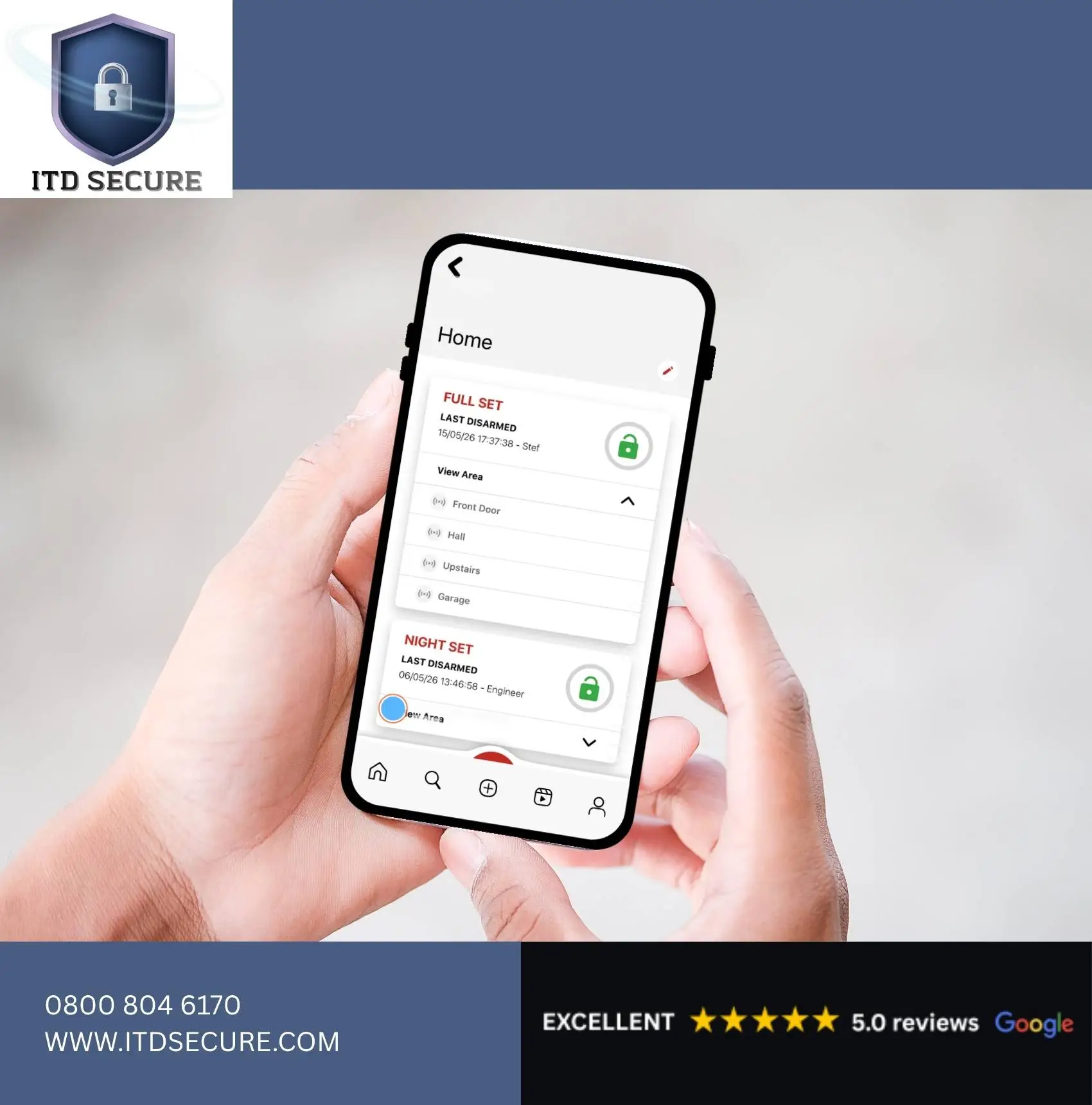
- You get app control. Arm, disarm, check status and see what triggered, from anywhere.
- Alerts go to every phone you nominate, not just one.
- Pet-tolerant detection where it is needed, so the dog stops setting it off.
- Grading to your insurer’s requirement — Grade 2 for most homes, Grade 3 where the policy or the risk calls for it.
- The old kit is removed and taken away.
Why reusing your old parts is not always the bargain it looks like
We can often reuse some of what is already there, and where that makes sense we will do it — it saves you money and there is no virtue in replacing a part that works.
But there is a trap in it worth understanding before you ask for it. Modern panels ship with protections that older detectors simply cannot speak to. Anti-jamming is the clearest example: a current system continuously listens for the radio interference an intruder would use to stop a wireless detector reaching the panel, and it raises the alarm when it hears it. Older devices have no capacity to take part in that conversation.
So when we mix old detectors into a new panel, the panel has to be reprogrammed down to accommodate them — dropping the very features that made it worth fitting. You keep the older parts and you lose the protection. At that point you have not really bought an upgrade. You have bought a replacement panel that behaves like the one you already had.
That is the judgement we make on a survey, and we will explain which way it falls on your system and why. Sometimes reusing parts is sensible and we will recommend it. Sometimes it quietly cancels out the reason for doing the work at all, and we would rather tell you that before you spend the money than afterwards.
After the upgrade — what actually happens when it goes off

As standard, the moment the system triggers a notification goes to every phone linked to the alarm, so everyone in the household knows at once. Beyond that, monitoring by a professional alarm receiving centre is available as an option at additional cost, so a trained operator is handling it whether or not you have seen your phone.
One thing worth knowing, because not everyone will tell you: the phone alert travels over your broadband. In a power cut the panel battery keeps detection and both sirens running exactly as normal, but the router goes down and the notifications stop with it. That is true of every internet-connected alarm sold, whatever the brand — the dependency belongs to domestic broadband, not to the panel. If it matters to you, a mobile signalling path gives the system its own route out, or a small UPS keeps the router alive. We raise it at the survey and recommend based on the property, not on price.
How much does a home alarm upgrade cost?
Tell us what you have and we will give you a realistic estimate straight away, by phone or WhatsApp. Nobody should have to book a survey just to find out whether they are looking at £600 or £2,000. The fixed written price comes after a free survey, once we have seen the property and know what your insurer expects.
An upgrade is usually cheaper than a first-time installation of the same size, because the groundwork — where the property is vulnerable, where detection needs to sit — is already half answered by the system in front of us. What moves the cost:
- The number of zones and sensors
- Wireless or wired
- The security grade your insurer requires
- Whether the system is monitored
- Pet-friendly detection
Give us a rough idea of what you have got and we will give you a realistic figure the same day. 07508 384864, or WhatsApp us.
Alarm upgrade questions we get asked
How do I know if my alarm needs upgrading?
The test is what happens when it goes off and you are not there. If nobody is notified, the system is doing half a job. Age matters less than that. We will come and look for free and tell you honestly whether yours is worth keeping.
Can you upgrade an alarm fitted by another company?
Yes. We will attend and review any old system, whatever the make, and be honest about how much use it still is. From there we either take over the existing panel or install a new system — including telling you it is fine as it stands, if that is the case.
My installer has stopped trading. What are my options?
This is common and not urgent unless something has actually failed. The system does not stop working because the company did. Book a free assessment, get it looked at and documented, and then decide — service it, upgrade the parts that need it, or replace it if it has had its day.
Will you have to rewire the house?
Almost never. Modern systems are wireless, so detectors go where the property needs them rather than where the old cable ran. That is what makes an upgrade a one-day job in a typical house rather than the fortnight of disruption people imagine.
How long does an alarm upgrade take?
A wireless upgrade in a typical home is a one-day job, and we would not expect it to run into a second day. Wired work in larger or commercial premises takes longer, and we will tell you exactly what to expect before anything starts.
Do I need to be at home for the assessment?
Yes, please. Most of the planning happens indoors — where the signal is strongest, which rooms need motion detection, which doors need contacts, and what the existing system is actually doing. An external look gives a rough idea only.
Can I add app control to my existing alarm without replacing it?
It can occasionally be done with a communicator module, but it is rarely worth it. By the time you have paid for the module and the labour you are a good way towards a new panel that does it properly, and you are still working around the limits of ageing hardware. We will tell you if yours is one of the exceptions — but usually we will recommend replacing it.
Can you keep my existing detectors to save money?
Sometimes, and where it makes sense we will. Be aware of the trade-off: older detectors cannot support features like anti-jamming, so the new panel has to be reprogrammed down to work with them. You save on parts and lose the protection you were paying for. We will tell you which way it falls on your system.
Is it cheaper to upgrade than to start again?
Usually, yes. The survey work is half done by the system already there, and on a wireless upgrade there is no rewiring. The saving depends on how much of the existing layout still makes sense for how you use the property now.
Will an upgrade satisfy my home insurance?
It should, provided the system is graded to what your policy asks for — Grade 2 covers most homes, Grade 3 where the policy or the risk calls for it. Bring your renewal wording to the survey and we will specify against it rather than guess.
Can you fit a pet-friendly system so the dog stops setting it off?
Yes. Pet-tolerant detectors discriminate by mass and movement pattern, and siting matters as much as the detector itself. A dog triggering the alarm is usually a siting problem as much as a technology one, and an upgrade is the natural point to fix both.
What happens to my old equipment?
We remove it and take it away as part of the job. If any of it is still serviceable and worth keeping in place — an external siren housing, for instance — we will say so rather than replace it for the sake of it.
Do you charge for the assessment?
No. We come out, look at what you have and tell you what we would do about it, free and with no obligation, and you get a fixed written quote for the work we recommend. If our answer is that your system is fine as it stands, that is what you will hear — but the visit is the first step towards a quote rather than a standalone advice service.
Free, no-obligation survey on 07508 384864, or send us a WhatsApp. We also service and maintain alarms already fitted across Kent, install burglar and intruder alarms from scratch, and fit CCTV alongside.